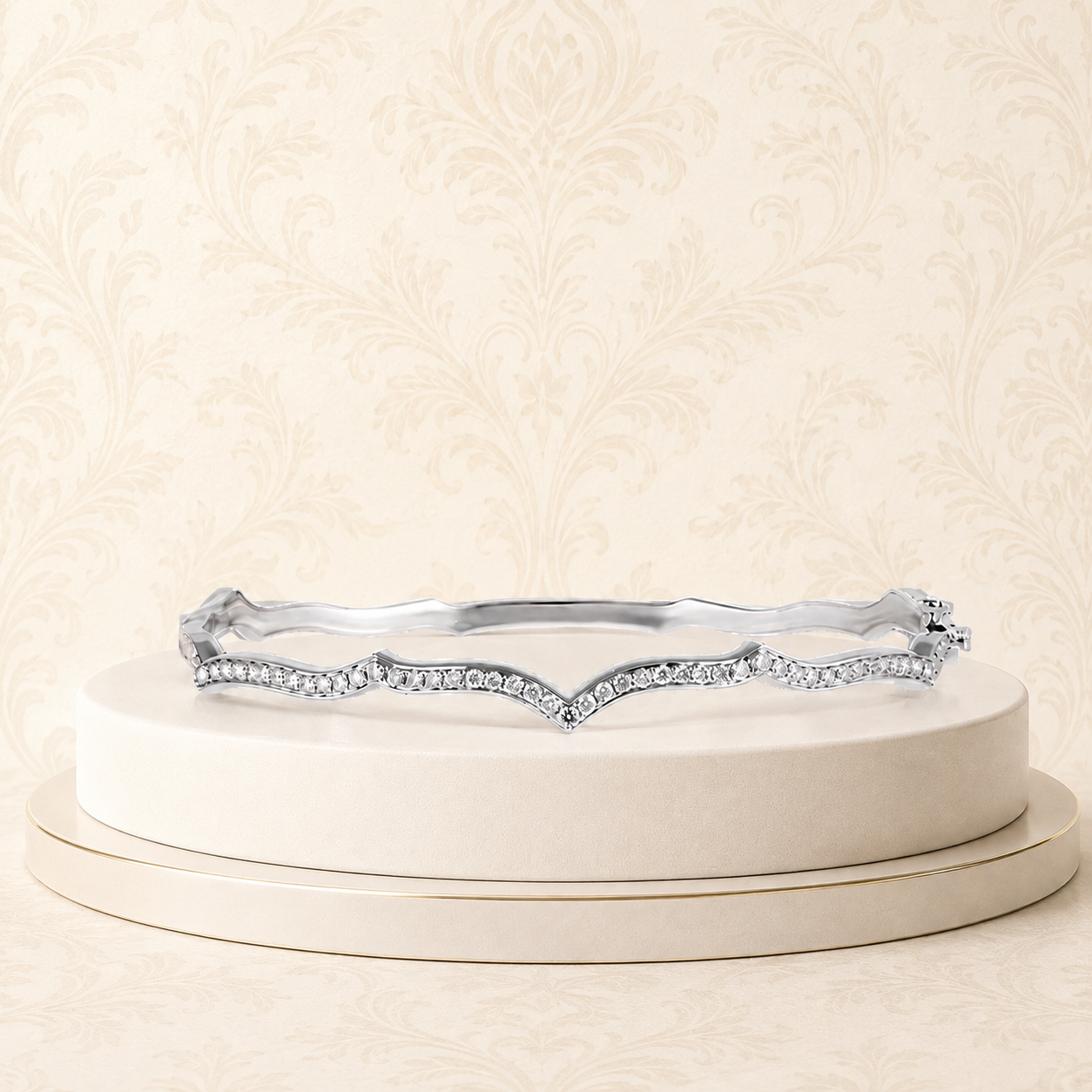
If you look around the typical jewelry counter, you will find the same types of bands, faceted stones and symmetrical settings. That's what a Bangle's are supposed to do, except for the Branch Affinity Bangle design, which is an exception on purpose. The tree is deliberately left with knits, forks and rough textured bark that a real branch would have. The aim isn't to simulate nature from a remote position. It's to get near it so the metal will remember its origin.
This style is one of the more prevalent designs at Jewel Teller's lines inspired by nature, and it all boils down to no two branches growing the same and no two bangles look the exact same. That's why it is so engaging and interesting when it happens!

Why Branches, Specifically
The leaves and flowers are what everyone notices about a natural jewelry piece, but branches have one thing the other motifs don't: Structure. There is already a bracelet shape in a branch! It is capable of bending, splitting, and tapering at both ends. An artisan is not a person who has to make up a silhouette for it is he who must discover it in a garden, in a forest, and must make it fit easily on his wrist for years.
Also textural issues. Bark isn't uniform. Prizes are almost impossible to imagine and get right when it develops cracks, peels and ridges. In fact, artisans specializing in this style typically use real branches, not photos, as touch is a useful method of conveying more meaning than a picture would provide.
Starting With the Real Thing
It is common for most Branch Affinity Bangles to start outside the workshop. Designed to collect actual twigs and small branches, whether oak, olive, birch or whatever has a sufficient amount of character, and to analyze the way the bark reacts at different points on the length of it. Thicker towards the base, thinner and smoother towards the tip. The small knots formed at the places where a leaf once was. These details are used as a reference for the completed work.
Many craftsmen take it a step further and incorporate the branch in the casting itself. A fine layer of wax or a mold-making compound is applied over a twig, after it is burned away when casting, and creates an almost precise replica of the surface with all the rings, cracks etc. This is slightly similar to the lost-wax casting technique used for centuries by jewelers, which has been modified for its use here to create an organic texture that is impossible to hand carve.
Others like to sculpt a branch shape completely in wax before casting; they use fine tools to work into the wax and sketch in the bark pattern. It's slower, but the designer has more control on how the bangle will sit on the wrist, which is more crucial with an irregular bangle than a simple band.
Shaping It Into a Wearable Bangle
Although it wasn't a real branch, and it wasn't built with the intention of being worn. To convert one into a bangle requires a number of practical issues to be addressed.
-
First is the curve. A bracelet must fit the wrist so artisans either use a section of branch that's naturally curved, or bend the cast metal after it is shaped but not sanded. This step tends to distinguish between an average piece and an absolutely good piece otherwise the bark-like detailing will be lost if it is not done correctly.
-
Second is weight. Silver, gold or our branches of solid bangles can become very heavy, particularly the silver. The bangle maintains its edgy appearance while at the same time not being quite as heavy to wear, as many of the designs are either hollowed out or made from a lighter metal.
-
The third is the closing. The frame of a circular bangle can be easily slid in and out. One that is shaped: This is likely to have a hinge made into it or have an opening to fit over the hand as it will otherwise be too thick in the middle and won't fit.
Finishing Touches That Make It Look Alive
The illusion doesn't have to be sold by the texture, it is sold by the color. After casting/constructing the piece and once the pieces take shape, the artisans use patina or oxidation to develop a dark color for the recesses, just as the grooves found in real bark are dark and created by age and weathering. The changes on the higher points are not extensive and light is reflected as it would be on smooth wood and worn bark. A metal branch on its own isn't something that needs to be treated. The finishing is good and, with a bit more, looks like it was retrieved on a morning stroll.
Some of these designs are further adorned with minor features, such as a bud, a leaf node or a slight bend where a twig would have broken away. These aren't decorative afterthoughts. It is them that lead the eye to believe that the piece grew and was not made.
Materials Artisans Reach For
Common reasons for the use of sterling-silver are its fine texture and its ability to retain it in a casting, while not being prone to oxidize when finished. Bronze and Brass are some good choices for a more "just dug up" appearance. The gold plated or full gold versions also come in, typically customizing those who wish the organic shape but more of a sophisticated presentation. The variety of metal not only affects the color but how deep the patina will reach, and how the bark texture will look in different lighting situations.
Why This Style Holds Up Over Time
Trendy jewelry styles are likely about to travel out of the fashion if there is another trendy shape round the corner. Even designs from the Branch Affinity collection from The Jewel Teller seem as if they aren't following the trends but instead are mimicking something which has not gone out of fashion.
Instead of looking like an addition, a well-constructed Branch Affinity Bangle blends into any outfit and thus fits naturally.
The key words: handmade vs mass-produced jewelry, if you are a design fan of handmade jewellery, then this is a High Jewellery design where the manufacturing process is definitely noticeable within the completed piece. One can observe the hours spent on studying real bark, the failure and success at bending a casting piece without losing any detail, and the hand-on hand patina created, against the sprayed-on uniform. That is not something you will get from a piece of stock stamped from a bulk.
FAQs
1. What makes a Branch Affinity Bangle different from other nature-inspired jewelry?
Most nature-inspired pieces borrow a shape, like a leaf outline or a flower motif, and simplify it into a clean design. A Branch Affinity Bangle keeps the imperfections: the bark texture, the knots, the uneven taper because those details are what make it recognizable as an actual branch rather than a decorative pattern based on one.
2. Is the bark texture on these bangles real, or is it engraved by an artisan?
It depends on the piece and the workshop. Some artisans cast directly from real branches, so the texture is a genuine impression of actual bark. Others hand-carve the pattern into wax before casting, working from studied reference branches.
3. Do branch-shaped bangles fit differently than regular bangles?
Often, yes. Because the shape isn't a perfect circle, many designs include a hinge, an opening, or a slightly flexible band so the bangle can slide over the hand comfortably.