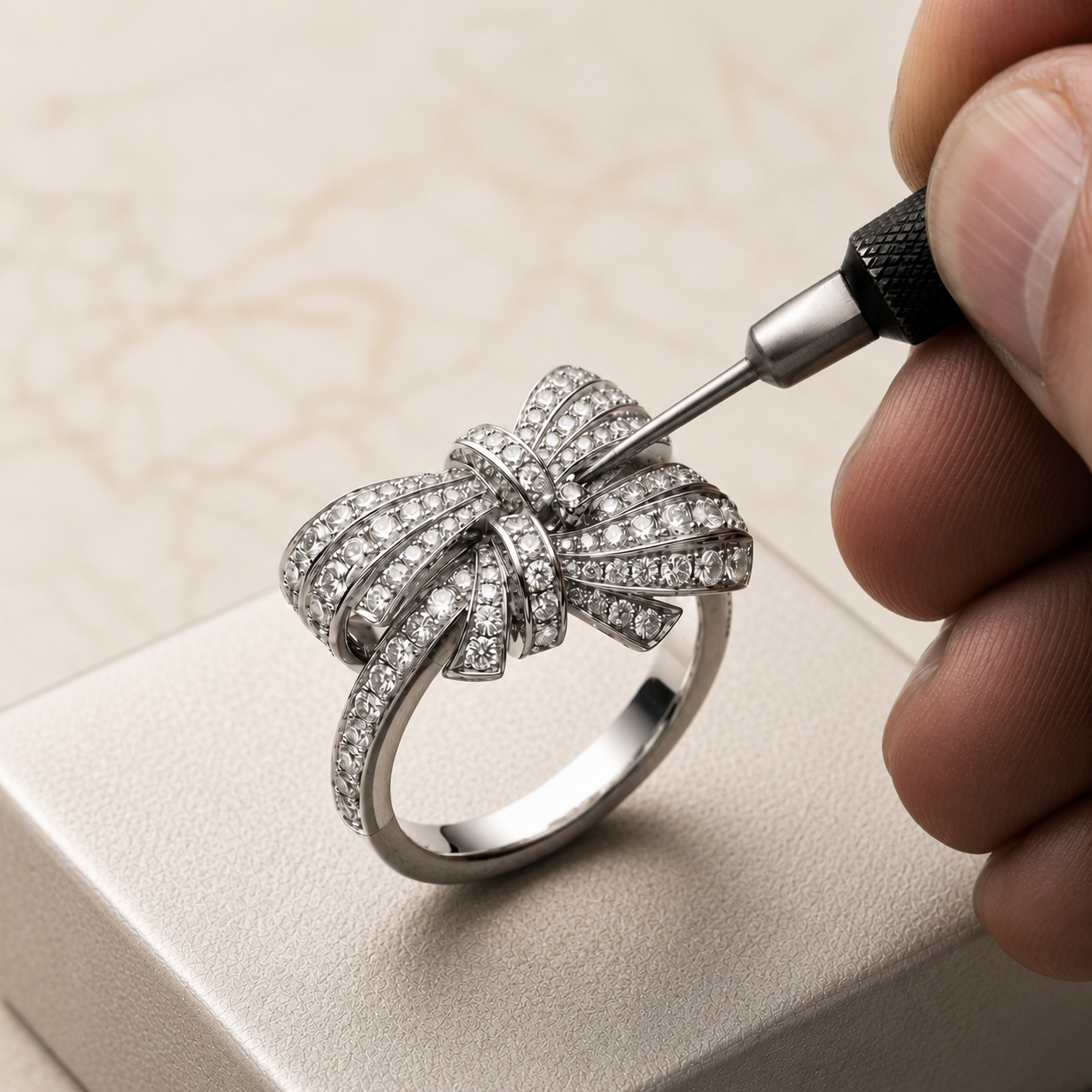
Knot rings confuse a lot of jewelers before they confuse the customer. Someone brings in their gold knot ring with diamond expecting a normal resize, the kind that takes twenty minutes at any counter. Then the jeweler picks it up, turns it over a couple times, and says they can't do it in-house.
Here's why. A regular ring has a band and then whatever sits on top of it, a stone, a design, an engraving. You can cut into the band without touching the rest. A ring from the Knot Collection does not work like that. Infact the knot itself is the ring. There is no separate base underneath it to cut and stretch. So resizing means reshaping the actual knot, keeping the diamond sitting exactly where it should, and making sure the twist still looks even from every angle after. Get one part slightly off and the whole ring looks lopsided.
This is the kind of resizing Jewel Teller handles regularly, not as a side job but as something we've built actual experience around.

The Knot Isn't Just a Shape, It's Structural
With a regular round band, resizing is rather common. A jeweller takes a cut on the back to remove or add a bit of the metal, which is then soldered over and the joint smoothed. Before and after the ring remains a circle.
A knot ring cannot be used in this manner. Tension is the property of an interlocking loop. All the curves are influenced by the others to stay in place. By cutting the wrong knot, not only will the knot's size be altered but also it may become loose due to the hard twist or sag in the center, rather than being neat and tight.
Now put in a diamond and the margin for error becomes even slimmer. The setting must remain ‘in line' with the curve. If the metal is moved slightly the stone might find itself crooked, if not, loose in its setting.
Where a Diamond Setting Adds Risk
This style is a bit more complicated to resize than others because:
-
Adding to the twist by mechanized stone placement. The diamond tends to move precisely where the loops intersect: precisely appropriately where stress is put on throughout resizing.
-
Heat sensitivity. Properly managing the heat when soldering around a diamond is important. While diamonds can withstand heat better than some gemstones, the metal or the prongs could be warped if the jeweler isn't able to be precise.
-
Prong alignment. Once resized, prongs should firmly fit back when closed. Small changes may cause a stone, even one, to become off-balance or to get stuck in clothing.
-
Symmetry of the knot. If the size is correct, but only one ring is resized, the ring may look out of balance.
Nothing here should send anyone a chill up and down their spine that discounts the idea of resizing their ring. That only makes clear why the employment is looking for somebody who understands how to do it before someone only familiar with normal ring repair.
Why Sizing Up or Down Isn't the Same Process
Resizing is frequently thought of as a one-way process that can be done in two directions. Not so in this complaint.
If they have a metal section their job is nearly always to size down which is to take a size of metal and get it back into the band. When it comes to the design of a knot, the jeweler must determine which knots are going to be able to have some material removed without compromising the visual balance. If you pull too much from one side, the knot will no longer look symmetric.
Sizing up involves adding on metal, and things get more delicate. Seam is visible on light if the added piece doesn't match the existing gold, either in color or karat. This seam may be covered with a plain band close to the bottom edge. The knot ring doesn't have a bottom where you can bury it. All the angles are in view.
In addition, there is a practical limit! Umbrellas are not enlarged or reduced more than a size or two at most jewelers, since it can cause too much difficulty. Immediate setback is experienced as the structure acquires new proportions once pushed further.
What Skilled Craftsmanship Actually Looks Like Here
An experienced jeweler who is knowledgeable in this style will do a few things differently:
On a magnifying lens, they inspect the knot to get an understanding of how the knot crosses and where the stresses are applied before making any snip. They check the setting for looseness before they heat it as a loose stone can work loose or fall out while they're heating it. They make small adjustments, and then test for symmetry, rather than all the adjustments in one go. And they do this not only on the seam but all over the ring, so that the repurposed area appears as a seamless texture and blends in with the surrounding ring (a different texture is not noticeably different).
Any of these steps can be skipped and the ring may have the correct size but be incorrect with the fitting in all other respects. Loose stone. Visible seam. Knots located just outside of the normal zone.
A resizing process is the same for Jewel Teller with regards to resizing interlocks and knots. The point of the goal is to give it back not pages under a sizing chart, it's to give it back, looking as if nothing ever happened.
When to Have a Knot Ring Checked, Even If It Still Fits
Some things point to the need for some attention before it is a much larger problem:
-
The pitch of the band changes from its original pitch.
-
The knot is crooked so that one side is lower than the other side
-
Of course, the diamond is tilted, as compared to the way it was bought.
-
The overlap of the loops is not uniform, making it visually apparent that it is thinning.
If these are caught early, they're typically a smaller fix. Changes may involve a complete re-forging of the shank which will be more expensive and entail more time.
Final Thought
A gold knot ring with a diamond is one of those pieces that uses virtually no metal to create a bang for its buck design. No wonder this High Jewellery from The Jewel Teller has become so popular. That's where it becomes impossible to resize it in the same way that you'd resize a regular band. The knot was tight, the point was solid and both of these elements needed to be balanced if the ring was to remain at the set quality that it had when day one happened to be picked.
When you're not certain you need a straightforward ring adjustment or perhaps an even more complex task, it is best to have any ring examined ahead of time.
FAQs
1. Can any jeweler resize a gold knot ring with diamond?
Technically yes, but not every jeweler has experience with interlocking designs specifically. It's worth asking whether they've worked on knot-style rings before, since the process differs from resizing a plain band.
2. How much can a knot ring with a diamond be resized?
Jewelers usually recommend that you stay within one or two sizes either way. Then, the ratio of the knot can begin to fall off.
3. Does resizing affect the diamond's setting?
However, it can, if not done carefully. That is why it's essential to have a good jeweler examine the setting for looseness before he begins and after the resize operation.